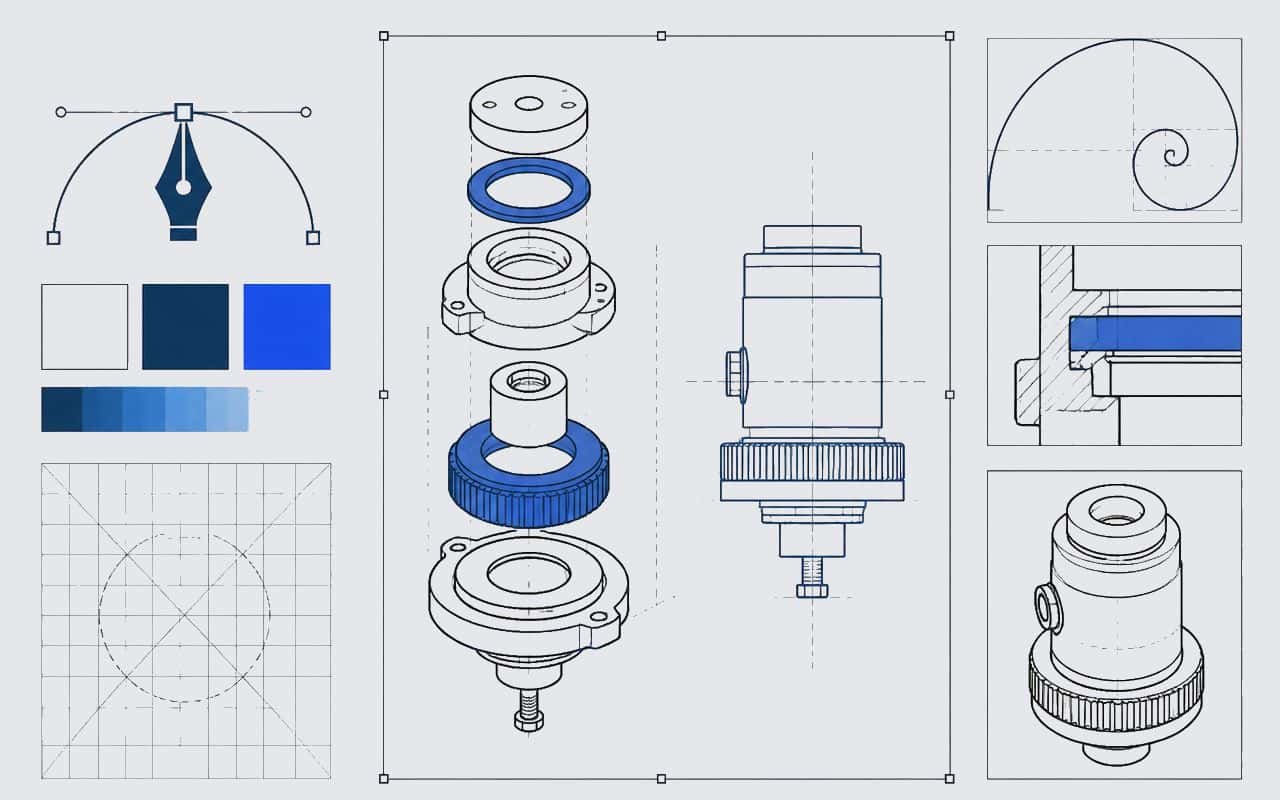

A consistent and memorable look.
Process
- 01
Brief
Industry, competitors, and usage contexts (web, signage, vehicle) are documented.
- 02
Direction
Two to three clean directions are presented. Too many options tire, not clarify.
- 03
Lock-in
Color, typeface, and negative (white) version are included in delivery files.
- 04
Application
Web, social, and print formats are derived from the same set.
What’s included
- Logo and corporate identity
- Color and typeface guidelines
- Social media visual set
- Web and ad banners
- Print-ready files
Who it’s for
- Those launching a new brand
- Those whose logo breaks everywhere
- Those with mismatched site and signage
- Those who can't keep up with campaign visuals
A logo must not be crowded
A good logo reads the name and survives at small sizes. If three shadows, four colors, and a slogan are crammed into the logo, signage and favicon die. Webify demands clean form and clear letter spacing. Decoration stays on the poster; the signature stays simple.
The negative version (white on navy background) is part of the delivery. If you stick with only a color PNG, night advertising and foil work won't hold. SVG, PDF, and usage share remain in the file.
Name registration is a legal matter; design registration is discussed separately. We deliver visual production and usage guidelines. Your lawyer handles trademark registration.
Corporate identity connects to the site
Color codes and typeface carry into web design exactly. The palette doesn't change across channels just to "make it a bit brighter." Identity guidelines are kept short: yes / no examples suffice.
Business cards, letterhead, and presentation covers come from the same grid. A new logo isn't drawn for each job. This preserves both cost and perception.
Social cover and post templates are the daily face of the identity. Without templates, every post looks like a different agency. Monthly production is a separate package; the initial set is delivered at handoff.
Web, signage, and vehicle from the same file
Signage and foil require vector. A bloated pixel JPEG strains the signage master. Print files (outline, bleed) are part of the graphic delivery; dimensions are discussed with the master.
Ad banners are exported at a weight that won't slow the site. "Highest quality" sometimes slows the page. Web and print exports are separate.
Trying to "fix a bit" the old logo is often harder than a new signature. The brief states why you don't like the old one; otherwise the same mistake repeats.
Duration and decision
Logo + basic identity is typically 1–3 weeks. Multi-stakeholder decision processes extend the timeline. The number of rounds is stated in the quote.
Ready-made "logo generator" output doesn't inspire corporate trust. It looks cheap and similar everywhere. When comparing, look at the file set and guidelines, not just the first mockup.
If graphics, web, and signage run from the same team, color deviation decreases. Three separate suppliers produce three navies.
What's in the delivery file?
The folder contains color and single-color logo, horizontal and vertical lockup, small icon (favicon candidate), prohibited usage examples, and short color/font note. The client shouldn't say "I'll extract the logo from Photoshop"; vector source is available.
Social cover dimensions (current platform ratios) are provided in the initial set. When platform ratios change, templates are updated; this small maintenance can be a separate line.
Printed proofs can be viewed at the office in Skyport. Remotely, PDF and screen sharing suffice. The decision is locked by email; verbal "a bit more" is not recorded.
No drawing starts without a brief
Industry, competitor trio, examples you dislike, and where the logo will appear (favicon, signage, vehicle door, invoice) must be written before the pen moves. "Make it modern" is not a brief; modern is something different to everyone. Webify fills this list in the first meeting and produces no direction without an approval email.
If the decision is multi-stakeholder, the number of rounds is written upfront. A separate approval round for each partner extends the project for months and crowds the signature. A single spokesperson and single lock email preserve both cost and consistency.
Competitor logos are put on the table so the same curve and same navy don't repeat. Differentiation is not adding decoration; it's simplifying letters and space. A signature that can't be read at small size dies on signage and social profile.
Font, license, and daily use
A typeface that appears free on the web may be licensed for signage. The delivery file states which font is used where and to whom the license belongs. "I downloaded it from the internet" is both a legal and visual risk.
Daily use: signature block, proposal PDF, presentation cover, social story. Without these, every employee breaks the brand in their own Canva. The initial template set is part of the identity; monthly production is in the social media package.
Web and print exports are separate. Screen HEX comes out differently on signage; CMYK and foil code are separate lines. If web design and signage run from the same team, this deviation is discussed once, not three times with three suppliers.